
Google Ads can be used to target potential customers searching for your products/services. It’s important to understand what you’re getting out of your advertising spend.
Instead of looking at clicks and impressions, it’s better to look at purchases, conversions and conversion values.
Creating reports for your Google Ads campaign will give you insight into what your advertising budget is yielding.
Below are some key Google Ads metrics that can help you understand how you’re doing with your advertising.
Understanding Your Latest Google Ads Campaign Results:
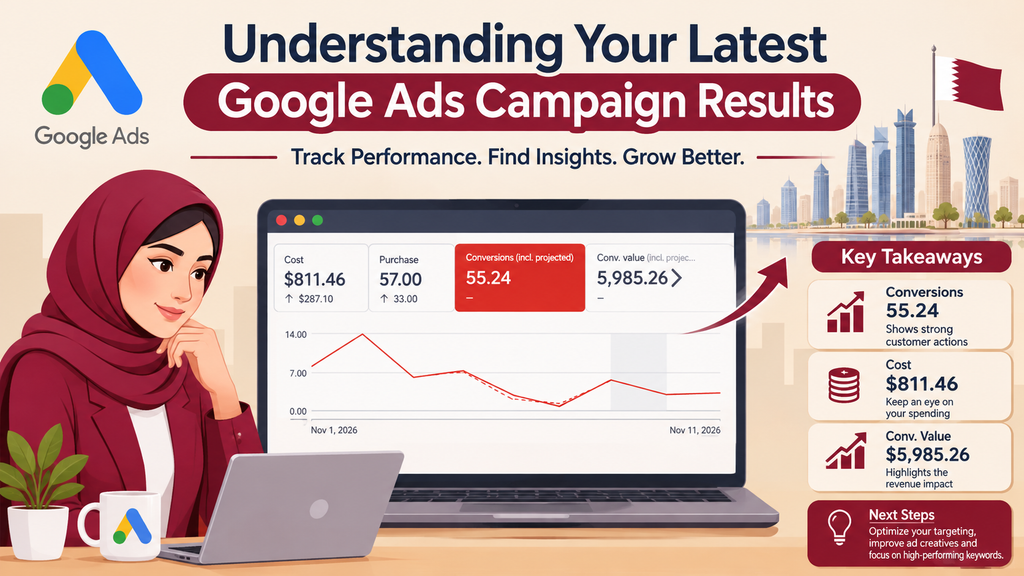
If we look at the below Google Ads Dashboard for 1st-11th November 2026, we can see:
Advertising spend: $811.46
Purchases: 57
Conversions (including projections): 55.24
Conversion Value (including projections): $5,985.26
This example shows how you can look at your advertising spend to see how your campaign is performing.
The advertising spend shows how much you’ve spent on ads within that period. By understanding purchases and conversions you can see how customers are acting.
Conversion values show you how much value your conversions are. This shouldn’t be seen as your net profit.
1. Understand Your Spend
The first thing you should look at is your total spend.
Within this example, we can see that we’ve spent $811.46 on Google Ads between 1st-11th November.
Understanding how much you’re spending on advertising can help business owners know how much they’re investing.
Understanding how much you’re spending on different campaigns, keywords and periods can help you understand where your budget is being spent effectively.
Keeping track of your advertising spend is key for small and growing businesses.
2. Look at Purchases
While clicks can be useful, this doesn’t necessarily mean you’ll see any results from your advertising.
Purchases are a much more meaningful metric for online stores. This means customers have actually made a purchase.
Within this example, we saw 57 purchases.
This can help you understand how your advertising is performing. However, it’s important to ensure you’re tracking purchases correctly. Accurate conversion tracking will help prevent double ups.
3. Understand The Value Of Your Google Ads
Conversion values will help you understand how much value you’re getting from your advertising.
In the example above, we can see that our conversion value (including projections) is $5,985.26.
This can be used to calculate your Return On Ad Spend (ROAS).
ROAS = Conversion Value / Advertising Spend.
Using the values from our dashboard:
$5,985.26 ÷ $811.46 = 7.38x
This means that we’re getting roughly $7.38 of reported conversion value per $1 spent on advertising.
Whilst this is useful to know, this doesn’t mean that we’re making $7.38 profit for every $1 we spend.
You’ll also need to consider the costs of your products, running costs, delivery costs and other costs.
4. Understand The Difference Between Purchases and Conversions
Purchases and conversions are similar but can differ.
Purchases are when customers complete an action. Usually this would be to complete an order.
Conversions can vary depending on how your Google Ads account is set up. You could be tracking purchases, form completions, phone calls or other valuable actions.
We can also see that there were 55.24 conversions (including projections).
As the purchases and conversions may be using different tracking and attribution methods, you shouldn’t assume they are the same. Make sure you understand what actions you’re tracking and how the conversions are being tracked.
5. Understand How You’re Performing Over Time
Whilst seeing how you’re performing in one period can be useful, it’s best to understand how you’re performing over time.
You could compare different weeks/months to see how your advertising is performing. This can help you understand if your spend, purchases and conversion values are increasing or decreasing.
If your advertising spend is increasing but your purchases aren’t then you may want to review your campaign.
If your conversion values are improving then you can look at what advertisements, keywords or products are contributing to this improvement.
By regularly reviewing your performance, you can make informed decisions about your advertising.
6. Improve Your Campaigns
Now you understand the numbers, you can look to improve your campaigns.
There are a few things you can look at:
Keywords – Are you showing for the right searches?
Ads – Ensure your ads are clear and explain what you’re offering. Encourage the right customers to take action.
Targeting – Are you targeting the right audience?
Landing Page – Ensure customers can easily find product information, pricing and contact details.
Conversion Tracking – Are you tracking purchases and other key actions?
Improving your campaigns regularly can help you get more value from your advertising.
7. Why You Should Look At More Than ROAS
Whilst ROAS is an important metric for your advertising, you should also consider:
Cost Per Purchase/Conversion
Conversion Rate
Total Purchases
Average Order Value
Customer Acquisition Cost
Revenue and Profit Margins
You may be getting a good ROAS from your campaign but this could be due to high product costs meaning you’re not making much profit.
By looking at a variety of metrics, business owners can get a clearer picture of their marketing performance.
Final Thoughts
Understanding your Google Ads reports can help you understand how your advertising budget is performing and if you’re getting any valuable actions from your customers.
From our example between 1st-11th November 2026 we can see that we spent $811.46 on advertising, had 57 reported purchases and a conversion value of $5,985.26. This means we had a reported ROAS of roughly 7.38x.
To ensure you’re managing your campaigns well, you need to ensure you’re tracking accurately, targeting the right audience, having effective adverts and reviewing your performance.
Ready to Get Started?
Orbition X builds WordPress websites, Shopify stores and landing pages from Doha. See our web development service or book a call and we will scope your project and give you an itemized quotation.