
Google Ads can be a great tool to attract potential customers, increase your services visibility and boost sales for your business. However, what can you do to ensure that your advertising spend is actually providing value?
Whilst receiving clicks, impressions and website traffic is a positive sign, businesses will need to understand how well their campaigns are performing in terms of their revenue or conversion value.
This is where ROAS comes into play.
ROAS (Return on Ad Spend) is a useful metric that can give insight into the value you are getting from your advertisement campaigns.
Take a look at how ROAS works and how it can help you implement better marketing strategies for your business in Qatar.
What is ROAS?
ROAS shows you how much conversion value you are getting per amount spent on your advertising campaigns.
The calculation for ROAS is quite simple:
ROAS = Conversion Value / Advertising Spend
For example, if you have spent QAR 1,000 on Google Ads and have gained QAR 5,000 of your tracked conversion value then you have a ROAS of 5x.
This means that for every QAR 1 that you spent on your Google Ads campaign you gained QAR 5 of conversion value.
The higher the ROAS the better your advertising campaign may be performing but you should also take into consideration any costs associated with your products, running costs and any profit margins.
1. Know How Much Value Your Advertising Is Providing
One of the main reasons businesses will look at ROAS is to understand the value they are getting from their advertising.
Say you are running Google Ads on your online store to increase visibility of your products. You may be getting lots of clicks on your ads, however, you will want to understand if customers are making purchases.
By looking at how much you are spending on advertising against how much you are gaining from conversions you can understand how your campaign is performing.
This can help business owners understand if they are getting the best from their current advertising strategy.
2. Use Real Data From Your Campaigns
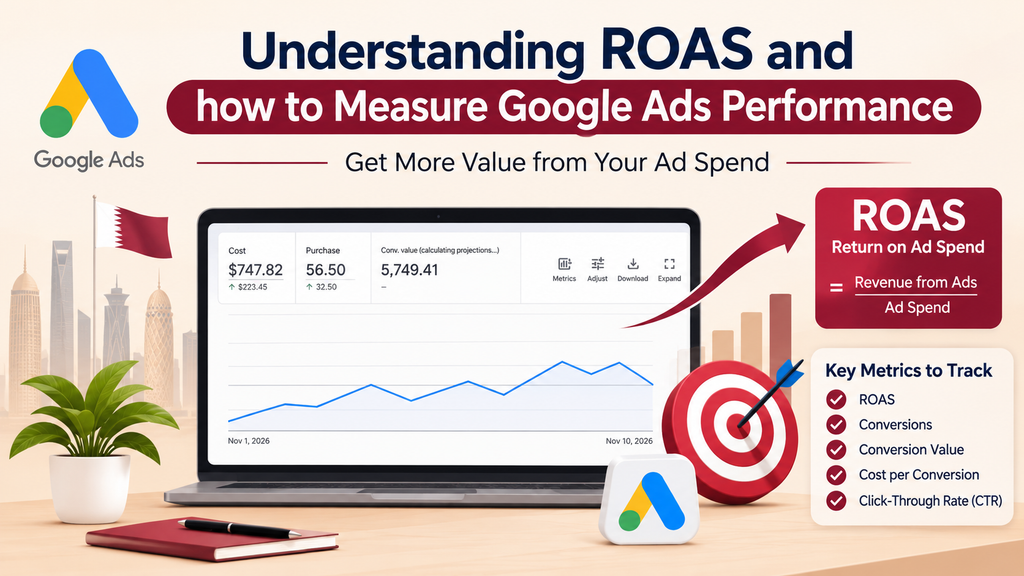
Let’s take a look at an example where we are using the data from Google Ads in our dashboards.
In the reporting period between 1st November and 10th November 2026 we can see:
Advertising Spend = $747.82
Purchase Conversions = 56.50
Conversion Value = $5,749.41
We can now calculate our ROAS by using:
$5,749.41 ÷ $747.82 = 7.69x
This means we are gaining approximately $7.69 of tracked conversions for every $1 we spent on advertising.
We can also see that on average we are spending around $13.24 per reported conversion.
This gives us a great example of how ROAS can help you understand your Google Ads campaigns.
It is also important to note that you may see decimal numbers for your conversions on Google Ads due to the settings of how conversions are attributed and measured. Your conversion value may also not be the exact amount of revenue or profits you are making.
3. Track Sales and Other Key Conversions
Not all businesses will track online sales as their key conversion.
For example, an eCommerce store may want to track completed sales whereas a service based business may want to track phone calls, enquiry forms, quote requests or appointments.
For example,
Real Estate Company may want to track property enquiries.
Dental Clinic may want to track appointment requests.
Restaurant may want to track online orders.
Cleaning Company may want to track quote requests.
It is important to track conversions that are aligned with your business goals.
Tracking conversions accurately is very important so that you can understand how your campaign is performing. If you are not tracking conversions accurately you may think that your campaign is performing better or worse than it actually is.
4. Understand the Difference Between ROAS and Profits
Having a good ROAS doesn’t mean that your business will be making a profit.
This is something to keep in mind when increasing your advertising budget.
Say you are running an online store and have a conversion value of $5,000 after spending $1,000 on Google Ads. However, you will also have costs involved such as your product costs, delivery costs, staff costs, payment processing costs etc.
Your actual profit may be much less after taking all of these costs into consideration.
It is therefore important to look at your profit margins, customer acquisition costs and other business costs in relation to your ROAS.
Understanding your full financial picture will help you make more informed decisions on how to spend your advertising budget.
5. Understand Which Campaigns Are Performing Better
If you are running multiple Google Ads campaigns then looking at ROAS can help you understand which campaigns are performing well.
For example, you may have multiple campaigns for different product categories on your online store. One campaign may be giving you a higher conversion value whereas another may not be giving you many conversions despite getting lots of clicks.
By looking at your campaign performance you will understand which areas need more focus.
However, you should also consider what the objective of your campaigns are, are your conversions of a good quality and what your attribution settings are.
You may have a low ROAS but this could be helping you gain valuable customers.
6. Improve Your Google Ads Campaigns
Measuring your ROAS can only help if you use the insights. If your campaign isn’t performing as you would expect, here are some areas to review.
Keywords – Are your ads showing for the right search terms?
Ad Copy – Are your ads clearly explaining what you offer and why someone should click?
Landing Pages – Are people finding the information they need easily?
Targeting – Are you targeting the right customers and locations?
Conversions – Are you tracking your sales, enquires and other key actions.
By regularly analysing your campaigns you can spot issues and make improvements.
7. Make More Informed Decisions On Your Advertising Budget
Once you understand which campaigns are providing value you can make more informed decisions on your advertising budget.
For example, if you are getting valuable conversions from your campaign then you could try increasing your budget. However, if you aren’t getting any meaningful results from your campaigns then you may need to update your targeting, keywords and landing pages.
You don’t want to increase your spend too quickly as this could impact your performance. Instead slowly make changes and monitor your results.
This can be a great way for small and growing businesses in Qatar to make the most out of their limited marketing budgets.
Other Google Ads Metrics to Monitor
Whilst ROAS is helpful there are other metrics you should also look at.
Cost – How much you have spent.
Clicks – How many people have clicked on your ads.
Impressions – How often your ads have been shown.
Conversions – How many conversions you have gained.
Cost Per Conversion – Average cost per reported conversion.
Conversion Value – Value given to completed conversions.
Conversion Rate – Percentage of conversions from ad interactions.
By looking at these you will have a better understanding of how your campaigns are performing.
Final Thoughts
ROAS can help give you an understanding of how much conversion value you are getting from your Google Ads against your advertising spend. This can help you to understand how your campaigns are performing, compare your campaigns and make more informed marketing decisions.
However, to have a successful advertising campaign you need to have accurate tracking, targeted ads, good landing pages and a good understanding of your actual profits.
Ready to Get Started?
Orbition X builds WordPress websites, Shopify stores and landing pages from Doha. See our web development service or book a call and we will scope your project and give you an itemized quotation.