
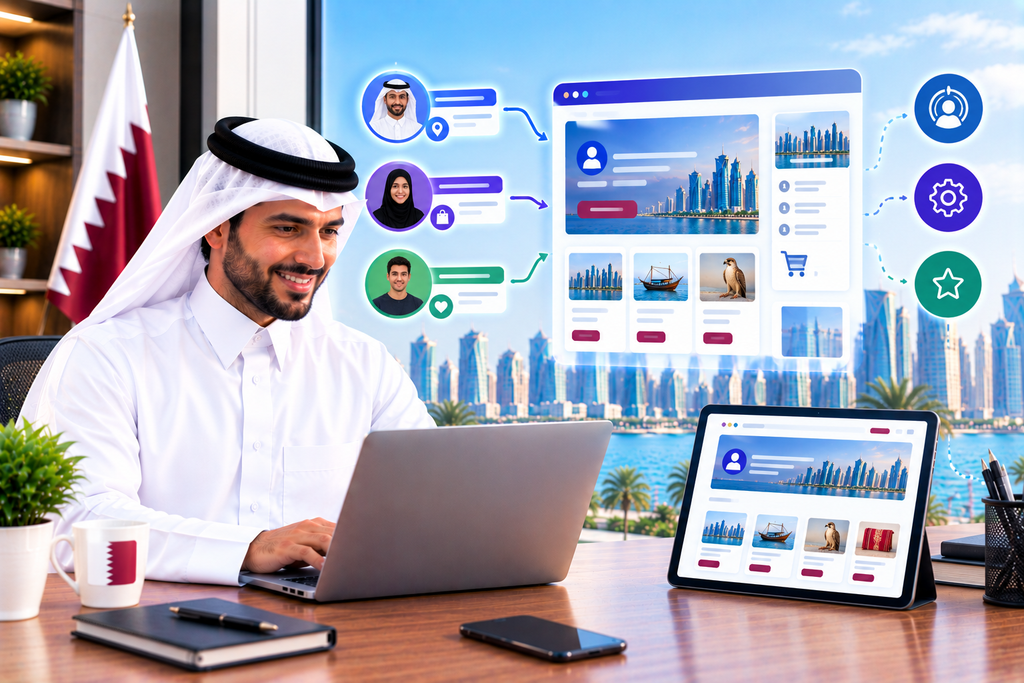
Many businesses in Qatar now require their website to be more than a place where company information is available online. Customers are now used to websites that make sense to them, help them find relevant information when they need it, and support them at every stage of their journey.
Website personalisation can help businesses to do just that
. By using tailored information, customer behaviour and preferences, a website can be more tailored to fit the requirements of different audiences
When used correctly, personalisation can help visitors navigate a website, have a better overall experience and be more likely to complete the actions that the business wants them to do.
Website Personalisation – What is it?
Website personalisation is a term that refers to a website being tailored to the information of a user or interaction
For example, a website can show relevant products, services, content or other things based on a user’s previous views.
Personalisation doesn’t always mean that a website is different for every single person that views it. Even small hints can make a noticeable difference.
Why Web Personalisation Matters For Businesses In Qatar
The customers of businesses in Qatar vary greatly, and what one person needs from a website is likely to be different to what another will need.
A professional service may have different information that it wants to show to somebody that is looking to hire them versus a returning customer that is familiar with the company.
Having relevant information on a website can make it far easier for customers to understand an organisation and what it offers. A more personal experience can also help to reduce confusion and make a website easier to navigate.
Provide More Relevant Information
One of the most obvious ways that personalisation can benefit a website is by providing more relevant information to the visitor.
For example, an e-commerce website can provide product recommendations based on what a customer has previously looked at. A service based business can show a relevant service based on the page that a customer is currently reading. The idea is simple, show the users of the website information that is more similar to what they are interested in.
Personalisation Can Help Improve The Experience Of The Visitor
Most visitors to a website will not want to spend a lot of time finding the information that they are looking for. If a website can make relevant information a little bit easier to find, it can provide a much more convenient experience.
This is especially true for businesses in Qatar that offer customers many options, products or services. The convenience of a well executed personalisation can help to help customers to navigate a complex set of offerings without confusion.
Product Recommendations
E-commerce businesses will have far more opportunity to use personalisation to recommend relevant products to their customers.
By showing visitors products that are similar to ones that they have viewed, are interested in or may want to buy based on other customers’ interactions with the website, businesses can help customers to discover products that they didn’t originally intend to look at.
Service Suggestions
While e-commerce businesses will benefit massively from personalisation, service based companies can use it to help their own websites.
A digital marketing agency could, for example, show visitors information about SEO if they are interested in search marketing, or alternatively, show advertising information if they are interested in paid marketing. This can help to provide a sharper experience for website visitors.
Smart Location Based Personalisation
Location based personalisation can be a great tool, but it’s important for businesses in Qatar to be careful with it.
Visitors to a website may be interested in services offered in particular areas or in information related to the local market. However, businesses should always be careful not to assume too much about their visitors and, instead, focus on providing the information that the visitor needs rather than intruding.
Personalisation Can Help With Generating Leads
In addition to helping customers to find relevant information, a personalisation can also provide an increase in leads to a business.
By providing relevant services and helpful calls to action based on what the visitor is interested in, customers will be more likely to complete the actions that the business wants them to do.
For example, a customer that is viewing a certain service page could be shown a relevant consultation or quotation option.
As the call to action is being targeted to the visitor, it will likely be of much more interest to the customer and, therefore, have a higher chance of being completed.
Content On Websites Can Also Be Personalised
Content on a website can be personalisation in a similar way to products and services. Different articles, guides or recommendations can be shown to visitors based on what they have read or viewed.
For example, someone that is reading about website development could be shown a relevant article on either the cost of a website or the different development approaches that they could choose. This can help to encourage the customer to be more engaged with the website and continue to learn about what the business has to offer.
AI Can Help With Web Personalisation
Artificial Intelligence can really take website personalisation to the next level. By utilising AI, businesses can get very clever recommendations based on the behaviour of the visitor.
For example, AI can provide businesses with information about the products that a visitor is interested in, or what content they may want to read or watch based on their previous behaviour.
However, businesses should focus on making the personalisation useful and not overwhelming the visitor.
Personalisation Can Help Returning Visitors To A Website
Returning visitors to a website may know more about a business than first-time visitors. As such, it’s unlikely that they will be interested in the same content that they have already seen.
A website can be much more useful to a returning customer by, for example, suggesting new products, relevant content, recently viewed products or other items based on their previous views.
Don’t Use Overly Specific Personalisation
It’s important that businesses ensure that their customers aren’t put off by overly specific personalisation.
If a customer visits a website and feels that they are being watched, it can have an adverse effect on the overall experience of the customer and, ultimately, the business itself
Careful personalisation is likely to have a positive effect on the experience of the customer, while overly specific recommendations may turn visitors off the website or its services.
Collect Only The Necessary Information From Customers
In order to personalise a website, businesses will need to know something about their customers. Businesses should, therefore, be careful to not ask for anything that they don’t strictly need to know.
By collecting only the information that is necessary and acting responsibly with the data that the company has, businesses can build the trust of customers.
Not Everything On A Website Should Be Personalised
Although personalisation can be a great tool, it should not be implemented everywhere. Important information such as contact details, company information and descriptions of services should always be accessible to all customers.
Simple changes to a website will likely have a bigger impact than adding personalisation features to a large number of elements that customers interact with.
Personalisation Can Work Well With SEO
Personalisation and SEO are two areas that can work well together, but it’s important for businesses to understand how they should be used together.
Search engines need to be able to see and understand the content of websites in order to accurately rank them. Personalisation should not stop search engines from being able to see the important information that a website contains
Essentially, businesses should ensure that the core content of the website is easy for search engines to access, while using personalisation where it makes sense.
Measure The Performance Of Personalisation Features
Businesses that implement personalisation features on their websites should look to measure how well these features are working.
By analysing visitor statistics, businesses will be able to understand how people are interacting with personalisation elements and whether they are being successful at what they are trying to achieve
If a personalisation feature isn’t working, it may need to be changed or, ultimately, removed.
Small Steps Can Make A Difference
Implementing personalisation on a website doesn’t always have to be a huge undertaking. Businesses don’t need to redevelop their entire websites, add complex features and worry about every aspect of personalisation. Businesses can start with small steps such as:
- Product recommendations
- Service recommendations
- Content recommendations
- Recently viewed products
- Relevant call to action options
- Returning customer experience
- Location based personalisation (where appropriate)
Once a business has started to implement small changes and seen the benefits that they bring, it can build upon them and add more advanced features.
Common Mistakes To Avoid With Website Personalisation
One of the biggest mistakes that businesses can make with personalisation is to use it just because they can.
If a personalisation feature on a website isn’t providing much in the way of benefits, it should be reviewed to understand why and, if it cannot be fixed, removed.
Another mistake is to ask for excessive amounts of information from customers. Businesses should make sure that they are focusing on what is necessary for personalisation and are not asking more information than they know what to do with.
Final Thoughts
Website personalisation can help businesses in Qatar to provide a much more relevant and convenient experience for their customers. By utilising product recommendations, service suggestions, helpful content and other personalisation features, businesses can help to guide their customers to what they are interested in and, ultimately, increase conversions.
The key to successful website personalisation lies in a good understanding of customers and the use of technology to improve the experience that they have at a business’ website. By combining personalisation with good website design, quality content, website analytics and responsible use of customer data, personalisation can be a powerful tool for businesses in Qatar.
Ready to Get Started?
Ready to get started? Orbition X builds WordPress websites, Shopify stores and landing pages from Doha. See our web development service or book a call and we will scope your project and give you an itemized quotation.