
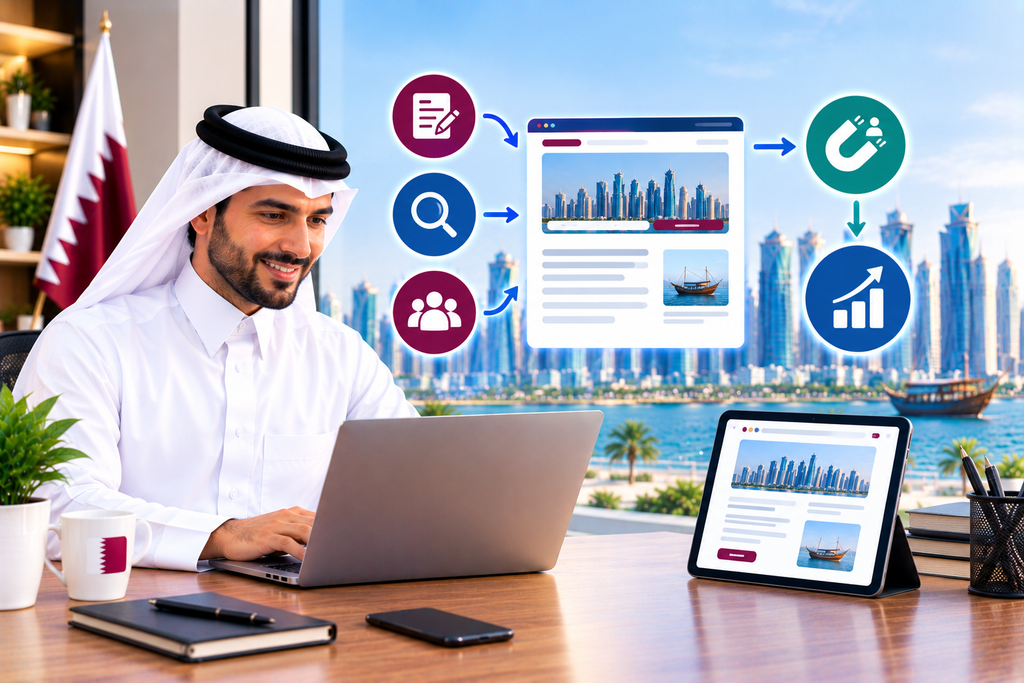
For many businesses in Qatar, a website remains a key place for potential customers to discover them online. They will arrive at a business’ website to understand what it offers, find key information about its services and make the decision to get in touch.
With that in mind, website content is critical.
Whilst a website’s design is unquestionably important, there must be valuable content for a customer to stay on a webpage and convert. Useful, relevant copy will allow businesses to highlight their services, answer potential customers’ questions and ensure their website remains engaging.
For businesses in Qatar, good website content can support customer acquisition and conversions.
What Is Website Content?
Website content refers to the body of text, information and valuable material that a visitor will find on the pages of a website.
This content typically includes homepage copy, service pages, product descriptions, blog articles, frequently asked questions (FAQs), case studies, customer testimonials and contact details.
Every piece of content plays a part; some elements support a website’s search engine optimisation while others build trust with visitors and encourage conversions.
Why Website Content Matters for Qatar Businesses
When someone is considering getting in touch with a business, they will want to know more about what it can offer. Customers need to understand the available services, assess whether it has the required level of experience, and ensure they will receive a satisfactory level of care.
Thanks to clear, informative content, a business can offer potential customers the answers they need before they speak to a member of staff.
For businesses in Qatar, this can make their website a more valuable resource for a customer.
Help Customers Understand Your Services
One of the most important roles of a business’ content is to explain what it does.
Service pages in particular should outline the key selling points of the service, who it can benefit and how it can help a customer.
Businesses should avoid overcomplicating their copy in an attempt to sound professional. The use of simple, accessible language will make it easier for a visitor to comprehend their offerings and determine whether they can help them.
Answer Common Customer Questions
Many potential customers will inevitably have the same questions about a business’ services.
They may want to understand pricing, availability, process, timelines and what they receive when they purchase a product or service.
A website can help answer these questions by providing clear service pages, as well as dedicated FAQs and informative blog posts. These pieces of content eliminate any uncertainty a potential customer may feel and encourage them to make the next step by visiting a business’ contact page.
Create Content Around Customer Needs
Businesses should create content around their customers’ concerns, rather than simply writing about their services from their own perspective.
For instance, instead of focusing on their company values, a business could use their service pages to explain what problems they can solve for a customer.
If a business specialises in web design, for instance, they could use their service page to describe how websites can generate leads. A company that offers SEO services, meanwhile, could provide more information on how they can make a business more visible in search engine results.
Website Content Can Support SEO
Content is also an important element of search engine optimisation. Search engines need to read and understand the information contained on a webpage, and relevant, well-structured content will allow a website to rank highly on search engine results pages.
Businesses across Qatar can focus on producing pieces of content around their services that are relevant to potential customers. This may include information about where in Qatar they operate, any frequently asked questions, and topics potential customers may be searching for.
As ever, businesses should create content with their customers in mind, not search engines. Whilst keywords are important, a page filled with repetitive keywords that does little to inform a visitor will prove far less effective at generating conversions.
Use Relevant Keywords Naturally
Keywords can support a business in targeting the right customers. They can allow businesses in Qatar to reach the relevant customers who have searched for terms related to the company’s services.
Keywords should be used on a business’ website in a natural way. They should feature in headlines, the body of web copy, page titles, and other relevant pieces of content.
The goal is not to force keywords to appear on the page unnaturally, but instead to write informative, helpful content that targets the right keywords.
Create Strong Service Pages
Service pages can be among the most crucial elements of a business’ website. Webpages should be informative and easy to follow, explaining concisely what each service offers, who they can benefit, and why the business in question is the right choice for the customer.
Ideally, businesses should also include a clear call to action, such as requesting that the visitor get in touch.
Build Trust With Website Content
For any potential customer, trust has to be built with the business before they will take the next step.
Website content can be invaluable at this point. Businesses can use their service pages to outline their experience, process and the success they have had in the past. They can do the same for testimonials and case studies, allowing the company to demonstrate what it can achieve for visitors.
For businesses in Qatar that operate in highly competitive sectors, this could give them an advantage over the competition.
Use Case Studies to Show Real Work
Case studies are particularly useful for businesses offering service-based products online. As opposed to outlining merely what a company does, a case study presents a real-life example of the business operating.
A case study typically details the challenge a customer faced and how the business helped to solve it, with outcomes explained where relevant. This can help reassure a potential customer that the company can deliver upon its promises.
Keep Content Easy to Read
Unless the body of the article is particularly small, website users will not read all of the copy presented on a webpage. Instead, they will skim through the content, reading subheadings and the beginning of paragraphs as a way of finding the information they need.
A business’ content should reflect this; its paragraphs should be arranged and kept concise so that a customer can find the information they seek.
Large blocks of text prevent this and will result in a visitor becoming put off by the content on the page.
Add Calls to Action
Wherever a body of website content leaves a visitor wanting more, there should be a call to action. For instance, a business may write a service page that interests a customer, however if the page does not persuade them to request a quote, they are unlikely to follow up.
CTAs should be relevant, as well as clearly presented. As ever, the user must be guided, not pushed.
Keep Website Content Updated
Website content that is left untouched for years can leave a negative impression. If a page contains outdated pricing, incorrect contact details, or inaccurate information about a business’ services, customers may question whether it is a legitimate organisation.
Businesses must keep this content updated; doing so will help to ensure continued customer engagement and satisfaction.
Content Can Help Visitors Make Decisions
Whilst informative content supports engagement and conversion, it can also make it easier for a website visitor to make the next step. A customer may initially discover a business on Google, before visiting the service page and case study. The information they read can influence their decision-making, until they decide to fill in a contact form or call the business.
With this in mind, content should be informative for potential customers, allowing them to make the right decision about whether they want to make contact.
Combine Content With Good Website Design
Content remains integral to building a strong website, but it must be combined with a good website design. Users must be able to read a body of content on a computer or mobile without struggling to locate relevant titles.
As with everything relating to website design in Qatar, there is no reason that website content and website design cannot compliment each other.
Use Blog Content to Attract New Visitors
Blog content, in particular, offers potential customers an opportunity to learn more about the business and its services. A company can publish articles addressing common questions from customers. Over time, blogs can generate traffic and allow visitors who may never have been aware of a company to discover them.
That said, blog content should not created solely for the purpose of linking to a business.
Articles must provide value and address the concerns of real potential customers.
Content Can Support Lead Generation
Website content can be instrumental in encouraging a website visitor to convert into a lead.
A potential customer may find themselves on a website unsure of whether they are ready to take the next step. In this circumstance, good content allows a visitor to build understanding, awareness and the reassurance that they have made the right decision by contacting the company.
In this way, content is an extension of a business’ sales process. A well presented CTA then allows that interested visitor to become a lead.
Measure How Content Performs
As ever, the performance of website content should be measured consistently. Website traffic reports can be invaluable; if there are certain service pages receiving a high quantity of views but few engagements or conversions, businesses should consider revising their content and CTA.
By measuring the effectiveness of their content, companies can identify what is working and what they can change.
Avoid Writing Content Just for Search Engines
Whilst Google and other search engines are keen to push content that is relevant, informative and well written, website content must be written for human readers.
Keyword stuffing or unnecessarily using technical language will turn readers off and prevent engagement.
Rather than writing for search engines, a business should focus on creating content that can build engagement and deliver valuable information to customers.
How Qatar Businesses Can Improve Their Website Content
Businesses can begin to improve their content today. A good place to begin is with major elements such as service pages; do these clearly describe what each service can do for potential customers in simple copy? Do the service pages feature good use of CTA buttons, along with FAQs addressing common questions?
Are there good testimonials or any case studies available to help build trust with customers?
Beyond these elements, businesses can begin developing their blog content. Companies should focus on identifying common FAQs and publishing content addressing these issues. Businesses must ensure to update any of their content, particularly service pages, that may contain outdated information such as their contact page.
Businesses can improve the content on their website in small steps – but the results can be dramatic in terms of improving user engagement and website conversions.
Final Thoughts
Website content can play a crucial part in supporting businesses in Qatar to acquire more customers. By ensuring that their content is valuable and relevant, companies offer potential customers an easy way to learn more about the services on offer, allowing them greater ease in deciding to make a contact.
Whilst an excellent website design remains vital, businesses must ensure that they present valuable website content to increase engagements as well as conversions.
Ready to Get Started?
Ready to get started? Orbition X builds WordPress websites, Shopify stores and landing pages from Doha. See our web development service or book a call and we will scope your project and give you an itemized quotation.